In the design of stair systems for public buildings, industrial plants, municipal walkways, and marine projects, the selection of tread materials is a crucial aspect in balancing safety performance, construction costs, and long-term maintenance. Traditional carbon steel stair treads are prone to rust and slipping, composite panels have short wear resistance and lifespan, and stainless steel stair treads are expensive, making it difficult to achieve optimal overall performance. Stair treads with aluminium checker plate as the core material, thanks to the inherent characteristics of the material and the enhancement of the embossing process, offer multi-dimensional advantages in terms of safety and longevity, environmental adaptability, and engineering economy, making it the mainstream material choice for various stair projects worldwide.
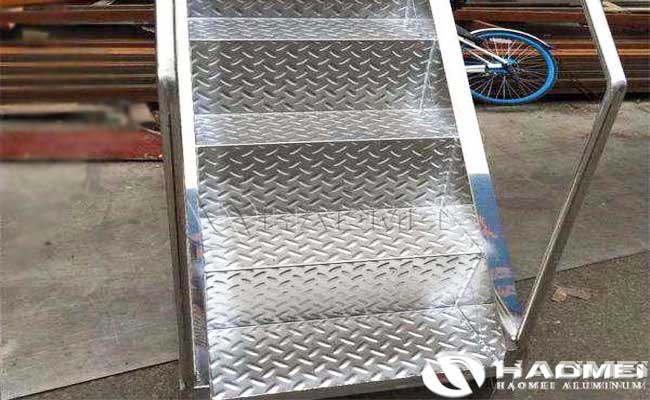
Long-lasting anti-slip safety is the core value of aluminum checker plate stair treads and the key reason for its replacement of traditional materials. Unlike carbon steel anti-slip textures that quickly fail with paint wear and plastic gratings that easily age, become brittle, and slippery, the anti-slip ribs of aluminium checker plates are integrally pressed and formed with the substrate, eliminating the risk of delamination and detachment. The rib height uniformity is controlled within ±0.05mm, maintaining a stable mechanical interlocking anti-slip effect even after long-term wear and tear. A standard five-bar tread can achieve a dry static friction coefficient of over 0.62, and maintains a friction level of over 0.42 in wet and oily environments, meeting international building anti-slip safety standards and effectively reducing the risk of slipping in high-traffic areas of stairs. For high-wear areas at the leading edge of the treads, alloy reinforcement can be used to increase local hardness and further extend the anti-slip life.
Excellent weather resistance and corrosion resistance are the core strengths that allow aluminum checker plates to adapt to diverse scenarios. Ordinary carbon steel treads typically exhibit paint peeling and substrate corrosion within 1-2 years in outdoor, coastal, and humid conditions. This not only drastically reduces their anti-slip performance but also causes rust to contaminate building facades. Aluminium checker plates, on the other hand, can be matched with different alloy systems depending on the working conditions: 3003 series rust-resistant aluminum has a built-in manganese passivation film, resisting daily humidity and industrial corrosion; 5052 series magnesium-aluminum alloy has excellent salt spray resistance, suitable for coastal and marine environments. No additional anti-corrosion coating is required throughout the process, and long-term use results in no rust or peeling. Its appearance and performance stability far surpass that of carbon steel, making it particularly suitable for outdoor and marine projects with high maintenance challenges.
The lightweight structural characteristics significantly expand the engineering applicability of stair treads. Aluminum alloy has only one-third the density of carbon steel, and aluminum checker plates of the same thickness are lighter, significantly reducing the load on stair joists and supporting structures. In old building renovations, temporary buildings, and lightweight steel structure staircase projects, using aluminium checker plate treads eliminates the need for reinforcement of the existing structure, allowing for direct installation and significantly reducing structural modification costs and construction time. Meanwhile, aluminum alloys boast excellent specific strength; a standard thickness of 2.0-3.0mm is sufficient for pedestrian and light-to-heavy load requirements, exhibiting no significant deformation or abnormal noise under foot traffic, balancing lightweight design with structural rigidity.
Flexible processing capabilities and end-life economic efficiency further amplify the value of this material. Aluminum checkered plate sheets support precise CNC cutting, folding, punching, and rounding, allowing for prefabrication of standardized step sizes and mounting holes. On-site installation requires only bolt fixing, eliminating the need for hot welding and secondary grinding, increasing construction efficiency by over 40% compared to carbon steel treads. From a life-cycle perspective, although the initial purchase cost of aluminium checkered sheets is slightly higher than ordinary carbon steel, it eliminates the maintenance expenses of regular rust removal and painting. Under normal operating conditions, its service life can reach over 15 years, and the sheets are 100% recyclable after disposal, resulting in a significantly lower overall cost compared to traditional tread materials.
Overall, aluminium checker plate, as a raw material for stair treads, do not excel in a single performance aspect, but rather represent the optimal solution in terms of safety, durability, adaptability, and economy, capable of covering diverse usage needs from indoor commercial buildings to extreme marine conditions.